News
New Molecule Class Creates Hardy, Drought Tolerant Plants
2026/08/05

As climate change causes water scarcity and temperatures to rise, crops around the world are feeling the heat. How can we prevent severe crop losses in these relentlessly sweltering conditions? An international research team led by Tohoku University has identified a new class of small molecules that enhances plant drought tolerance without any major negative impact on plant growth.
The findings were posted in Nature Communications on July 27, 2026.
When plants perceive drought stress, they synthesize a key phytohormone called abscisic acid (ABA). ABA basically tells the plants to close their stoma (similar to pores) to reduce water loss. While this defense mechanism is incredibly helpful at conserving water, ABA also mediates some unwanted responses, such as seed dormancy and growth inhibition.
“We want the plants to conserve water to improve survivability, but we don’t want them to suddenly stop growing,” explains Nobuyuki Uozumi (Tohoku University). “To achieve this ideal outcome, we devised a strategy of identifying compounds that inhibit molecules promoting stomatal opening.”
The research team focused on the stomata in a model plant (Arabidopsis thaliana). Stomata are partially controlled by a channel called KAT1, which triggers stomatal opening by adjusting how much K⁺ uptake occurs. In other words, KAT1 is trying to keep the doors open – not a good strategy during a drought. The researchers aimed to find KAT1 inhibitors to keep the door shut tight.
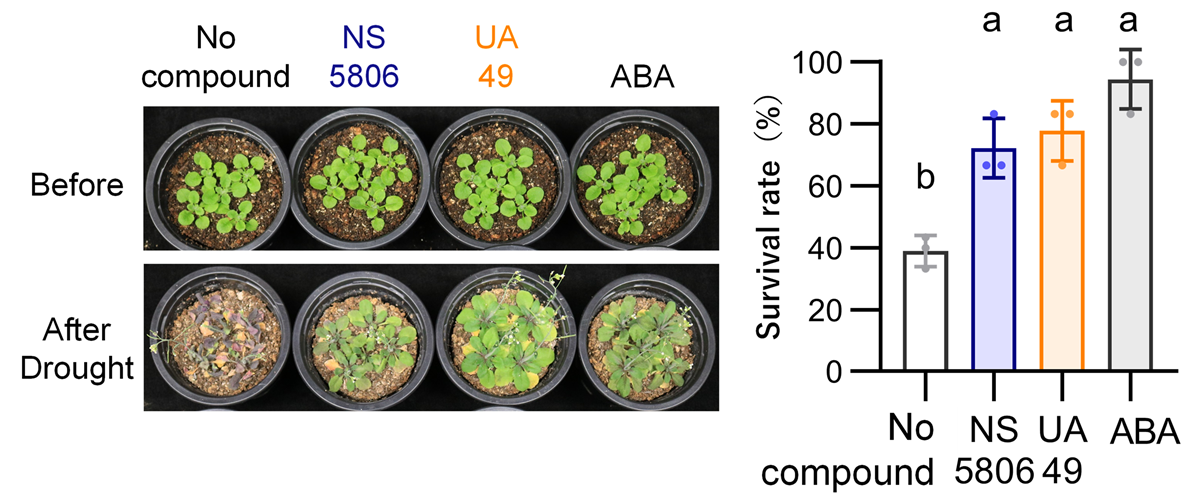
Drought tolerance induced by NS5806/UA49. After spraying NS5806/UA49, plants were subjected to drought stress (withholding water) and assessed for recovery upon rewatering. ©K. Sato et. al., Nat. Commun. (2026)
To identify inhibitors of KAT1, they performed an electrophysiological chemical screen and identified the small molecule NS5806. They then synthesized a derivative, UA49, by modifying its chemical structure. Application of either compound to leaf epidermal strips successfully induced stomatal closure and inhibited stomatal opening. Moreover, foliar application of NS5806 or UA49 enhanced drought tolerance in plants. Importantly, unlike ABA, neither compound caused undesirable side effects, such as delayed seed germination or inhibited root growth, highlighting their potential for agricultural applications like biostimulant.
In addition, the team elucidated the molecular mechanisms underlying the stomatal response induced by NS5806/UA49 – which was distinct from ABA. They compared normal plants to plants that were modified to lack KAT1 channels and looked at intracellular Ca2+ concentrations—a key mediator in signaling. In normal plants, there was a sustained influx of Ca2+ in the guard cells that open and close stomata. In plants without KAT1 (our notorious door-opener), this response was absent. These findings suggest that the regulation of K+ channel activity is intrinsically involved in the modulation of intracellular Ca2+ signaling, pointing to a novel, previously unreported possibility that K+ channels act as signaling mediators.
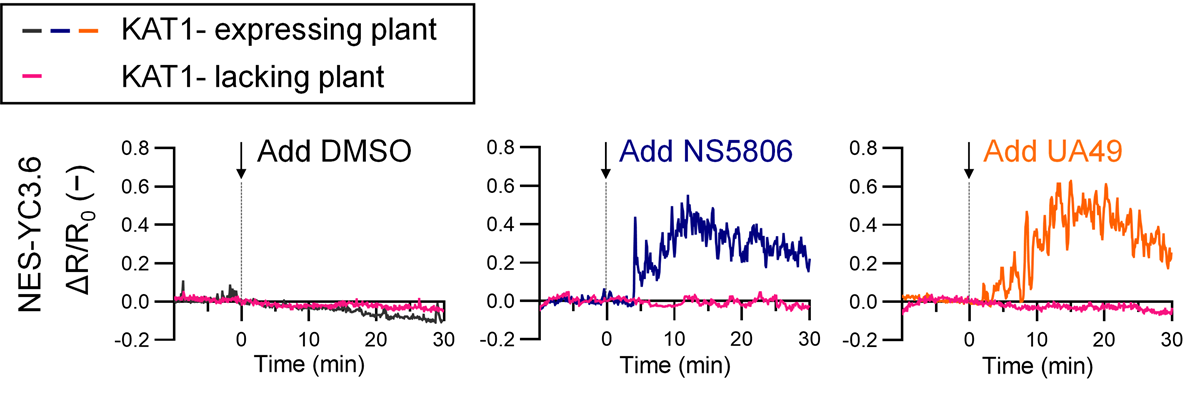
Intracellular Ca2+ influx mediated by NS5806/UA49. Rising values on the vertical axis indicate an increase in cytosolic Ca2+ levels in guard cells. This Ca2+ influx was detected only in KAT1-expressing plant. ©K. Sato et. al., Nat. Commun. (2026)
The international research team found two compounds that confer drought tolerance with fewer side effects than ABA, making them promising candidates for improving drought tolerance in major crops. The underlying mechanism was also investigated, further highlighting the details of how this strategy could potentially be applied. As climate change makes extreme drought a more common occurrence worldwide, further research in this area is crucial to help ensure that our food supply doesn’t just wither away.
Title: Synthetic ion channel inhibitors enhance plant drought tolerance
Authors: Kanane Sato, Kyota Suzuki, Shunya Saito, Taishin Kakei, Megumi Kato, Masana Yazaki, Yasutaka Kawai, Mieko Arisawa, Nobuhisa Isaka, Toshio Yamaguchi, Matteo Grenzi, Laura Luoni, Masaru Kono, Yuki Hayashi, Toshinori Kinoshita, Farhan Aziz, Khurram Bashir, Motoaki Seki, Asuka Kamimura, Takumi Higaki, Jun Takeuchi, Yasushi Todoroki, Huifei Yin, Francisco Rubio, Jörg Kudla, Shintaro Munemasa, Yoshiyuki Murata, Masaru Tsujii, Yasuhiro Ishimaru, Alex Costa & Nobuyuki Uozumi*
Journal: Nature Communications
DOI: 10.1038/s41467-026-75894-w
Contact
Nobuyuki Uozumi
Department of Biomolecular Engineering, Graduate School of Engineering, Tohoku University
Email: uozumi@tohoku.ac.jp