News
Researchers Identify "Green Thumb" Molecule That Drives Leaf Stalk Growth in Plants
2026/09/03
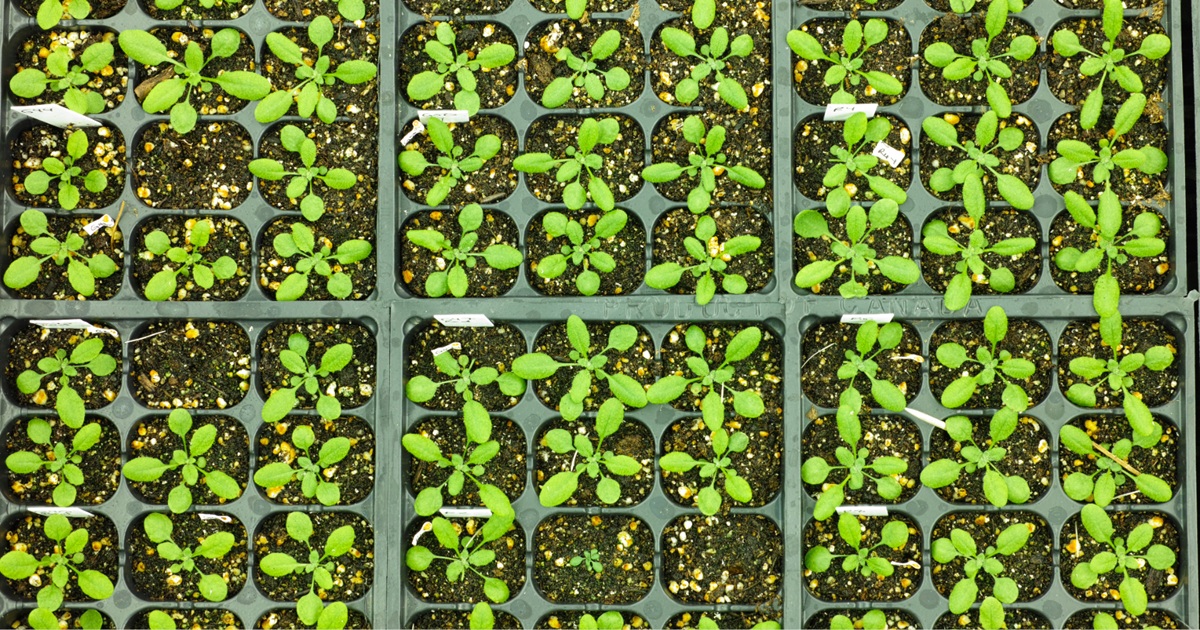
Potassium (K) is one of the three essential nutrients for plants. It plays a critical role in a wide range of processes, including cell growth, photosynthesis, and regulation of water balance. Plants take up K from the soil and circulate it throughout their bodies via molecules called K+ channels. The function of one such K+ channel (called AKT5) in the model plant Arabidopsis thaliana has remained a mystery, despite over 30 years of study. Understanding the gateways for what is essentially the lifeforce of plants is crucial for finding new ways to boost agricultural productivity.
To solve this mystery, the Uozumi laboratory at Tohoku University have identified the K+ channel activity of AKT5 from the Arabidopsis plant. This research represents the very first reveal of AKT5's actual function. Physiologically, AKT5 promotes leaf stalk growth, offering new insights into developing efficient high-density cropping systems.
"The leaf stalk is the edible part of many vegetables, such as celery and Swiss chard," explains Nobuyuki Uozumi. "By regulating AKT5 activity in these plants, it may be possible to tailor the size and texture of these stalks to meet consumer needs."
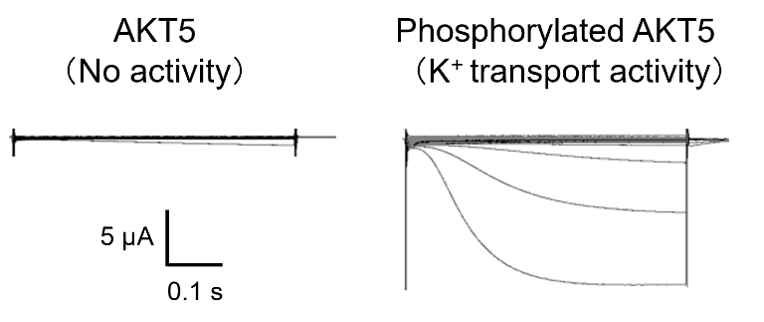
Electrical currents produced by AKT5 when activated by a specific enzyme. K+ ions carry an electric charge, so when they move into a cell, the movement can be detected as an electrical current © Y. Muraoka et. al., Sci. Adv. (2026)
The research group attempted to detect the K+ transport activity of AKT5 using animal cell expression systems. Initially, no activity was detected. However, when a specific enzyme that adds phosphate groups to proteins was introduced together with AKT5, K+ transport activity was detected for the first time. It turns out that AKT5 is activated when a phosphate group attaches to a specific amino acid in the protein, which is why there was no activity when K+ alone was added.
To better understand how AKT5 is activated, they used cryo-electron microscopy to determine its three-dimensional structure in the pre-open and closed states. AKT5 adopts a shape very similar to other known K+ channels, yet it can transform. In fact, when a single amino acid in AKT5 was changed (aspartate at position 403 was replaced with alanine), the structure of the molecule changed dramatically, and AKT5 gained K+ transport activity even without phosphorylation. These findings suggest that AKT5 normally adopts an inactive shape, and upon phosphorylation, undergoes a structural change centered around the 403rd amino acid, switching to an active shape that can transport K+.
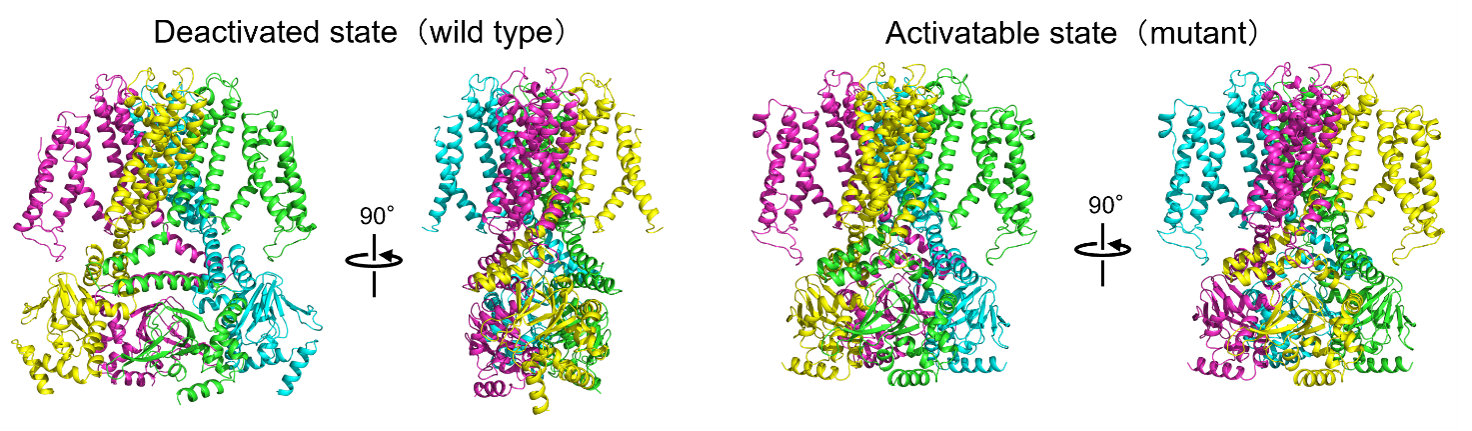
The three-dimensional structure of the AKT5 molecule. Left: the normal AKT5 in its inactive state. Right: a modified AKT5 (D403A) with a single amino acid change, which adopts an active shape and can transport K+ ions without phosphorylation. © Y. Muraoka et. al., Sci. Adv. (2026)
To investigate the role of AKT5 in plants, the researchers examined where AKT5 is located. They found that in plants, AKT5 is concentrated in the leaf stalks - the slender structures that connect leaves to the stem. When plants lacking AKT5 were analyzed, their leaf stalks were found to be shorter than normal. Leaf stalks are important for positioning leaves to capture sunlight efficiently, which becomes especially critical in crowded growing conditions. When AKT5-deficient plants were grown under crowded conditions, their growth was reduced and they became smaller compared to normal plants. These results suggest that AKT5 promotes cell elongation in leaf stalks by taking up K+, increasing internal pressure within the cells and thereby stretching the leaf stalks.
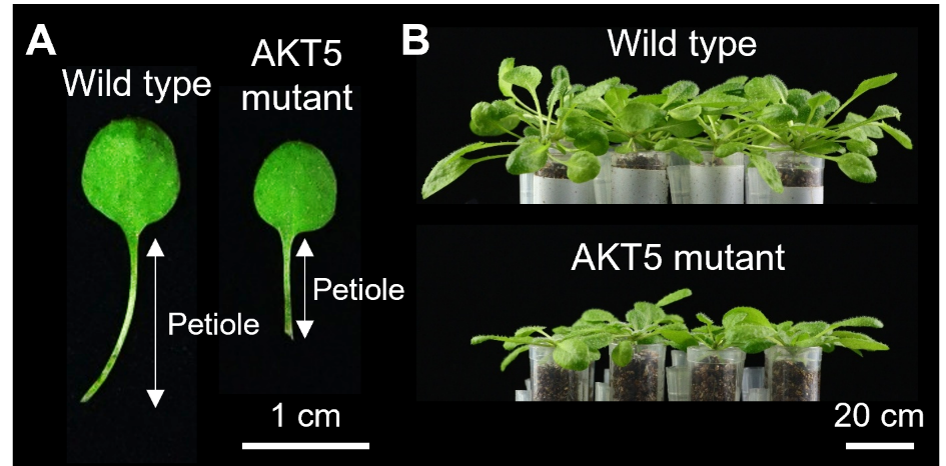
Leaf stalk length (A) and growth under crowded conditions (B) in normal and AKT5-deficient plants. (A) Plants lacking AKT5 have shorter leaf stalks (petiole) compared to normal plants. (B) When grown under crowded conditions, AKT5-deficient plants show reduced growth and smaller size compared to normal plants. © Y. Muraoka et. al., Sci. Adv. (2026)
AKT5 is a key molecule that helps plants compete in high-density growing environments. Gaining a deeper understanding of how AKT5 functions in plants and learning how to control its activity could enable us to grow crops at high density without reducing productivity. These findings are expected to provide an important foundation for addressing global challenges such as population growth and the shortage of farmland.
The findings were published in Science Advances on September 3, 2026.
Title: AKT5 is a bona fide potassium channel and controls petiole growth in Arabidopsis
Authors: Yuki Muraoka, Shunsuke Kobayashi, Lisa Oskam, Michihiro Tateyama, Ayumu Masago, Yoshikazu Tanaka, Takeshi Yokoyama, Tadaomi Furuta, Hinano Takase, Ellen Tanudjaja, Shota Terashima, Haruto Shimizukawa, Taro Yamanashi, Shunya Saito, Hiroki Ijima, Miyuki Tanaka, Atsushi Miyamoto, Megumi Kato, Kanane Sato, Masaru Tsujii, Taishi Umezawa, Francisco J. Quintero, Francisco Rubio, Jörg Kudla, Masaaki Ito, Yoshihiro Kubo, Yasuhiro Ishimaru, Ronald Pierik, and Nobuyuki Uozumi
Journal: Science Advances
DOI: 10.1126/sciadv.aeh7630
Contact
Nobuyuki Uozumi
Department of Biomolecular Engineering,
Graduate School of Engineering, Tohoku University
Email: uozumi@tohoku.ac.jp
Website: https://www.biophyschem.com/