News
Where Does Pitting Corrosion Start in Titanium-Containing Stainless Steel?
2026/10/23
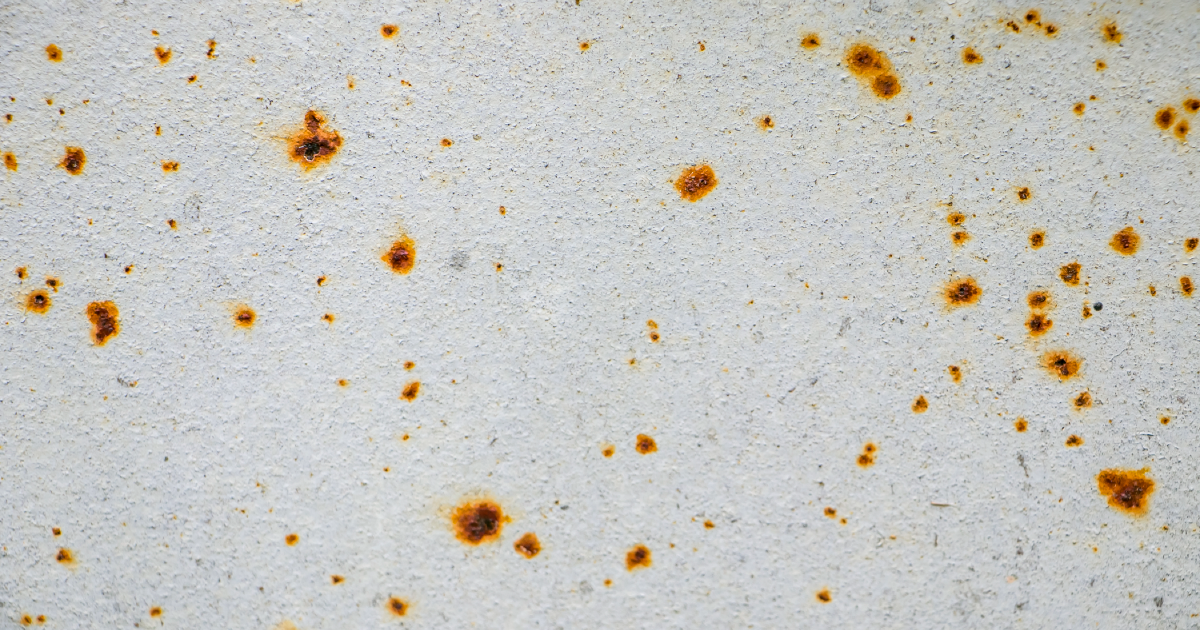
Stainless steel is widely used for its impressive corrosion resistance, but it is not invincible. In environments containing chloride ions, such as seawater, pitting corrosion can occur. These pits often start at tiny particles called inclusions embedded in the steel.
Titanium (Ti) is commonly added to stainless steel to improve pitting corrosion resistance by converting easily dissolved manganese sulfide (MnS) into more stable Ti-containing sulfides. However, Ti addition does not completely prevent pitting, and the electrochemical properties of the various inclusions formed in Ti-containing stainless steel - and which of them can trigger pitting - have remained unclear.
A recent study by researchers at Tohoku University has provided new insight into this complex question. The team studied a ferritic stainless steel, Fe-16%Cr alloy (Type 430), and prepared model specimens in which the composition of inclusions was systematically controlled. This approach allowed them to overcome a major experimental challenge: inclusions in commercial stainless steels are only a few micrometers in size, making it difficult to analyze the electrochemical properties of individual inclusions. Their findings may help inform the design of sturdier more resilient stainless steel used in home appliances, surgical tools, and car parts.
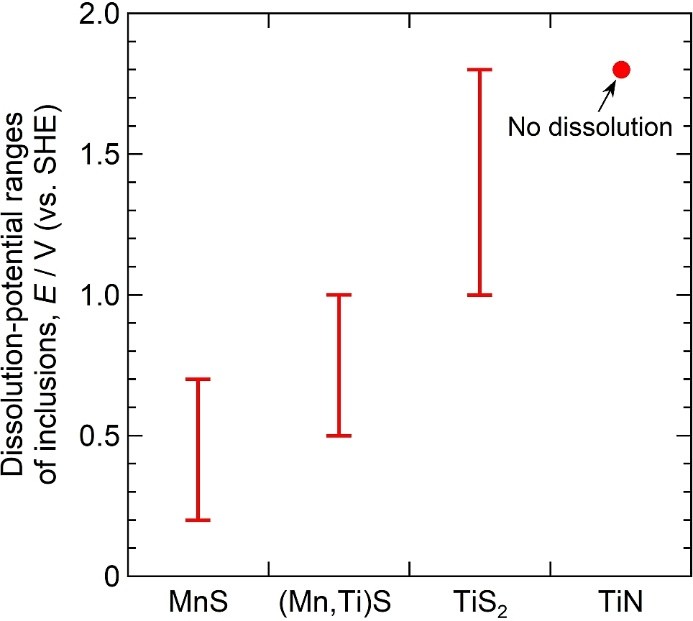
Different types of inclusions show markedly different resistance to dissolution. MnS dissolves most easily, followed by (Mn,Ti)S and TiS₂, while TiN did not dissolve within the range examined. The results show that the composition of inclusions plays an important role in their electrochemical stability. ©Jiaqi Gao, Masashi Nishimoto, Izumi Muto
Using microscale electrochemical measurements, the researchers compared four types of inclusions: MnS, (Mn,Ti)S, TiS₂, and titanium nitride (TiN). They found that MnS was the easiest to dissolve, followed by (Mn,Ti)S and TiS₂, while TiN did not dissolve under the conditions examined. Although Ti-containing inclusions were generally more stable than MnS, (Mn,Ti)S was relatively easier to dissolve than the other Ti-containing inclusions.
"Since the pits formed in commercial stainless steel are so incredibly tiny and hard to analyze, we started with a model specimen where we had a higher level of control," explains Masashi Nishimoto (Tohoku University). "We were very pleased to find that when we looked at the behavior of actual Ti-containing stainless steel, the results matched what we saw in the model specimens."
The potential at which pitting occurred matched the potential range in which (Mn,Ti)S dissolved in the model specimens. Detailed analysis of the pit-initiation sites also showed that pits formed at Ti-containing inclusions, with manganese (Mn) and sulfur (S) concentrated around the initiation sites. Together, these results indicate that small amounts of (Mn,Ti)S inclusions can act as initiation sites for pitting corrosion in Ti-containing stainless steel.
The findings highlight the importance of controlling the composition of sulfide inclusions to further improve the corrosion resistance of Ti-containing stainless steel. As a next step, the researchers plan to investigate the effects of calcium (Ca) - which is often added together with Ti in stainless steel production - with the aim of further improving the pitting corrosion resistance of Ti-containing stainless steel.
This research was published online in npj Materials Degradation on 22 October 2026.

Pitting corrosion initiated at a Ti-containing inclusion in Ti-containing stainless steel. Elemental mapping showed concentrations of Mn and S around the pit-initiation site. Combined with the electrochemical measurements of the model specimens, these observations indicate that small amounts of (Mn,Ti)S can act as initiation sites for pitting corrosion. ©Jiaqi Gao, Masashi Nishimoto, Izumi Muto
Title: (Mn,Ti)S inclusions as pit-initiation sites in Ti-containing Fe–16Cr stainless steel: insights from microelectrochemical analysis using artificial inclusions
Authors: Jiaqi Gao, Masashi Nishimoto, Izumi Muto
Journal: npj Materials Degradation
DOI: 10.1038/s41529-026-00902-9
Contact
Masashi Nishimoto
Department of Materials Science, Graduate School of Engineering
Email: masashi.nishimoto.c1@tohoku.ac.jp
Website: https://www.r-info.tohoku.ac.jp/en/2a52190e47b8d24cef8cbf251f54e623.html