News
Electrical Control of an Unconventional Quantum Transport State in Magnets Demonstrated
2026/11/05

Researchers at Tohoku University and Japan Atomic Energy Agency (JAEA) have successfully controlled a unique quantum phenomenon - the quantum-geometric nonlinear Hall (QgNLH) state - using electric current for the first time. The breakthrough was achieved by revealing and exploiting the coupling between the spin structure and the QgNLH state in an electrically switchable chiral antiferromagnet. The achievements offer a potential approach for developing electrically tunable devices that use quantum-geometric effects to perform nonlinear signal processing functions.
Details were published in the Cell Press journal Newton on November 4, 2026.
Going beyond Ohm's law
Electrical conduction underpins modern electronics. In an ordinary conductor, the voltage and the current are proportional, as described by the Ohm's law and the Hall effect. In some materials, however, these linear laws can be violated. A typical example is the nonlinear Hall effect, in which the Hall voltage appearing in the transverse direction of the current no longer follows the usual linear relationship.
Quantum geometry - the geometric structure of electronic quantum states - plays a crucial role in producing such an unconventional nonlinear voltage-current response. The corresponding quantum-geometric nonlinear Hall (QgNLH) state (Fig. 1) is therefore of interest both as a way to explore the quantum properties of solids and as a new basis for nonlinear signal processing. For practical electronic devices, however, it requires not only observing this response, but also controlling it by electric current. This has remained challenging because the quantum geometry has been interpreted as a built-in property of the material.
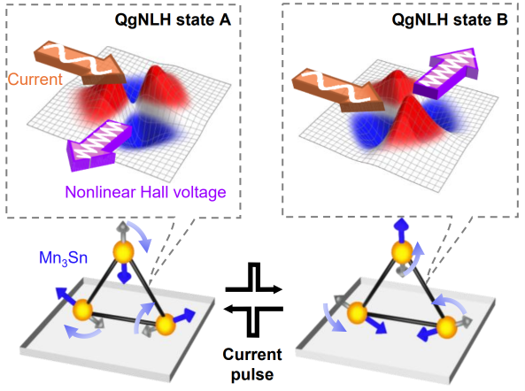
Schematic of electric-current manipulation of the QgNLH state with different patterns of quantum geometry and magnetic orders in Mn3Sn. ©Tomohiro Uchimura, Jiahao Han, and Shunsuke Fukami
Electrically controlling the response through magnetic order
The research team investigated epitaxial thin films of the chiral antiferromagnet Mn3Sn. Its spin structure is closely connected to its electronic states, making Mn3Sn a promising material to explore how the control of magnetic properties can be used to manipulate the unconventional responses from quantum geometry (Fig. 1). They first observed a third-order nonlinear Hall effect at room temperature, i.e., the nonlinear voltage is proportional to the cube of the current (Fig. 2). Combining experiments with theoretical calculations, they verified that the observed effect has a quantum-geometric origin and is reversible by switching the spin structure of Mn3Sn, hence revealing the interplay between the QgNLH state and the spin structure.
The team subsequently used spintronic approaches to electrically control the magnetic order and the associated QgNLH state. When an electric current flows in a heavy metal layer adjacent to Mn3Sn, the resulting spin-orbit torque acts on the spin structure of Mn3Sn and is capable of switching it. In their experiment, the researchers switched the sign of the third-order nonlinear Hall response by applying current pulses with opposite polarities (Fig. 3), thus demonstrating the electrical control of the QgNLH state through current-induced magnetic dynamics.
"We are able to realize on-demand electrical manipulation of the QgNLH state under different external conditions", noted Tomohiro Uchimura, leading author of the paper. "Deterministic switching and fluctuation of the QgNLH state can be achieved under finite and zero bias magnetic fields, respectively."
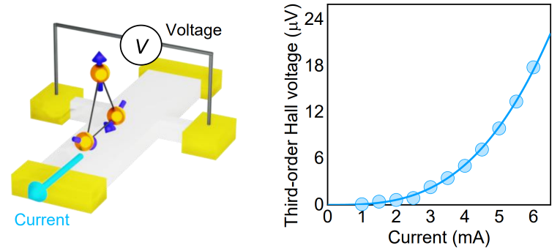
Detection of the QgNLH state in a Hall bar device of Mn3Sn. The nonlinear Hall voltage is proportional to the cube of the current. ©Tomohiro Uchimura, Jiahao Han, and Shunsuke Fukami
Towards electrically tunable nonlinear electronics
The corresponding authors of the paper, Jiahao Han and Shunsuke Fukami, further discussed the significance of connecting quantum geometry, nonlinear electronics and spintronics in this study. "Instead of treating quantum geometry as a fixed property of the material, we showed how the nonlinear electronic responses from quantum geometry can be actively manipulated by electrically controlling the material's magnetic order. The approach may help to develop electric-current-tunable nonlinear devices such as frequency multiplexers and rectifiers. They have the potential to benefit from the inherent advantages of magnetoresistive random access memory (MRAM) in energy efficiency and speed, owing to the introduction of spintronic methods that made the manipulation possible."
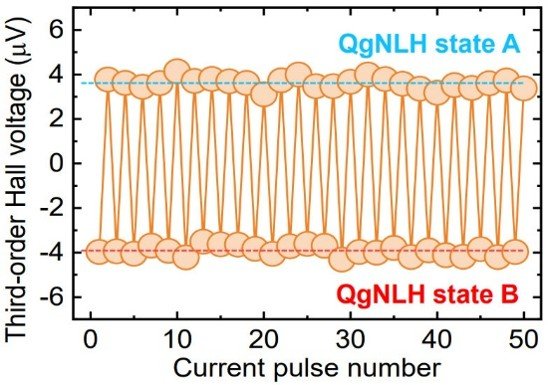
Switching of the QgNLH state by alternating positive and negative current pulses. ©Tomohiro Uchimura, Jiahao Han, and Shunsuke Fukami
Title: Electric-current manipulation of quantum-geometric nonlinear Hall state in a chiral antiferromagnet
Authors: Tomohiro Uchimura, Jiahao Han, Yasufumi Araki, Yuta Yamane, Shun Kanai, Jun'ichi Ieda, Hideo Ohno, and Shunsuke Fukami
Journal: Newton (Cell Press)
DOI: 10.1016/j.newton.2026.100722
Contact
Shunsuke Fukami
Research Institute of Electrical Communication, Tohoku University
Email: s-fukami@tohoku.ac.jp
Website: http://www.spin.riec.tohoku.ac.jp/en/